Winter Triticale Harvest 2026
At ProGene, we pride ourselves on providing high-quality seed tailored to customers’ specific needs. One way we achieve this is through plot and strip trial research. Below are examples of our process from the 2026 Winter Triticale harvest.
It starts with our team, with the help of farmers, organizing and mapping out where and what we are going to plant. For Fall-planted varieties, we aim for around the first week of October, and for Spring-planted varieties, the middle to end of March (weather dependent). The seed is then organized, counted out, and labeled in accordance with where they will be planted within each specific field.
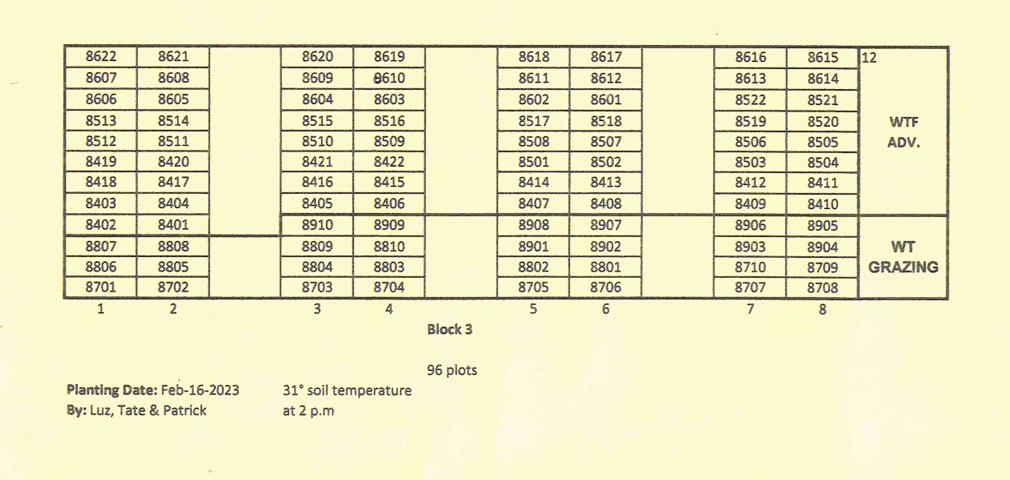
From there, we treat every seed packet with seed-treatment (to help with early growth and mitigate disease pressure) and place them in the correct planting order before heading to the field for planting. One by one, we plant each plot in a 5’ x 10’ rectangle (or 5’ x 20’). The amount we can fit in a field varies each time. Due to the volume of varieties we now have with our many years of business, some of our field blocks can have upwards of hundreds of plots. Just this year alone, we have around 1,100 plots.
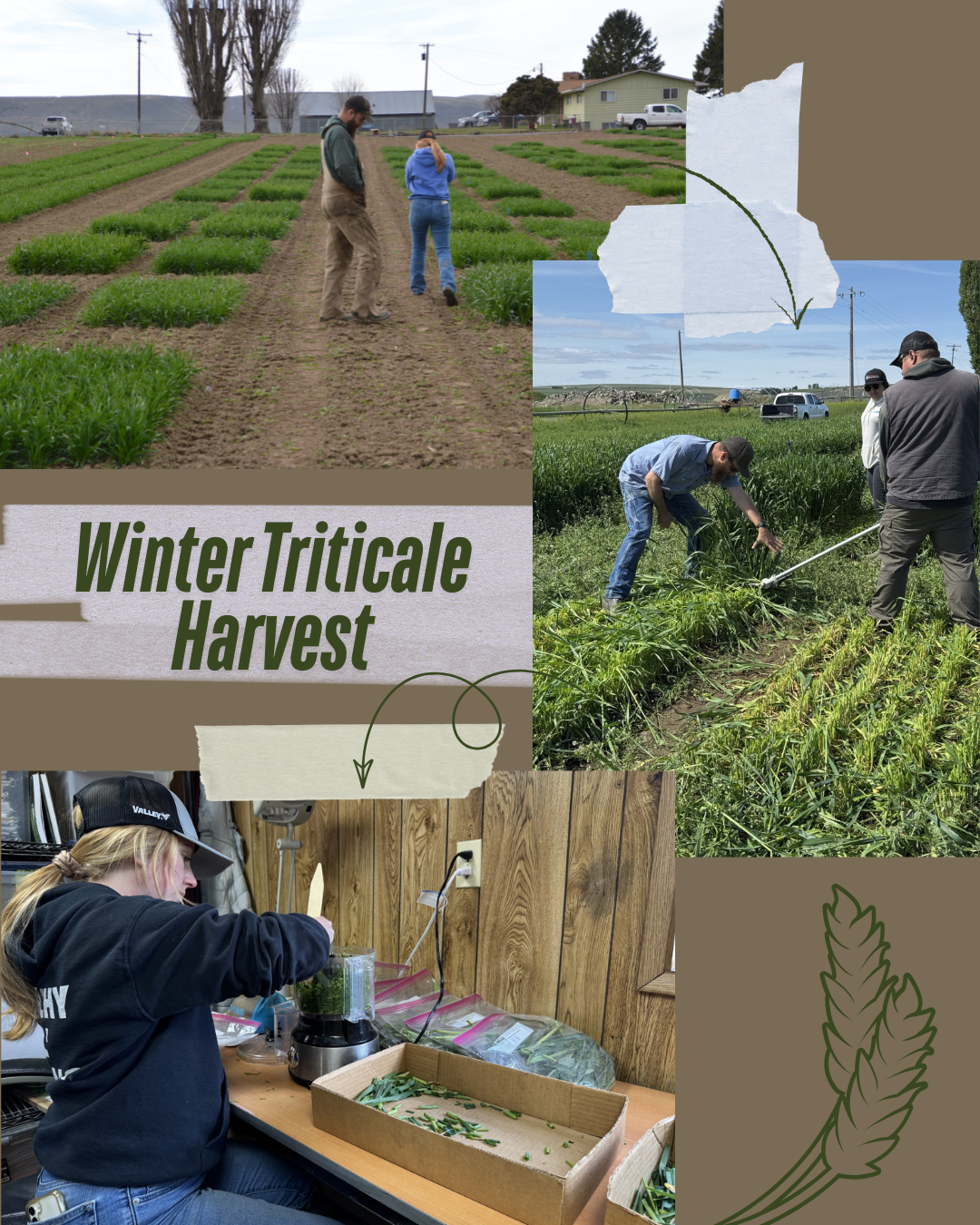
During growth, the team collects information on each plot, one of the first being what we call “early vigor”; each plot is ranked on a scale from 1-10, based on visual early-stage growth and uniformity. Next, on the day of harvest, we collect a sample consisting of 4 individual plants of boot-stage triticale (or 1 pea and 3 triticale if it is a blend) and place them in a bag. Each bag will contain a sample of the same variety from each of the three replicated plots. We bring these back to the office and blend them in a food processor (so that the sample is uniform), which will then be sent to the lab to test moisture and protein content.
Harvesting time varies for each crop type. For winter triticale specifically, we wait until we see pre-head emergence, or what we call “boot stage”. Once around 80% of the plot has reached this stage, we harvest. Once for forage and grain types, and 3 times every two weeks for grazing varieties. We then trim the front of the plot around 6” to 1’ to eliminate the skewing of data caused by the edge effect (where plants on the edge of plots have less competition). We then measure and mark out 6’ on the plot and harvest up to that mark into bins, then carry over to a team member, who takes down the weight for every plot. Overall, weight is used to determine yield. These can then be given to the farmer to determine which crop fits their goal for the field. This can vary from protein (for feed/silage) to tonnage, depending on what market the farmer wants to grow for. That being said, the goal could also be both protein and tonnage. But without our testing, we would be reliant on data from our growers, with many factors such as field size, soil health, planting rate, etc., rather than a controlled (as much as possible) environment.
As our varieties and our team continue to grow, and we strive to bring our growers the best varieties in each category, no matter the application. If you would like more information on our process or would like to see the varieties that are in plots currently, please contact us or visit our office!
(Below are photos of our process with a few of our team members, featuring Ryan and Grace in photo one. Ryan, Luz, and Tate are in photo two. And Grace again in photo three. Following the photos is an example of one of our field maps.)